How digital companies can turn climate promises into measurable action
As digital transformation continues to accelerate, so does its energy footprint. From cloud platforms and telecom infrastructure to artificial intelligence and data centres, the digital sector is a major contributor to global emissions, and yet, its climate performance remains largely unaccounted for.
A new report from the International Telecommunication Union (ITU) and the World Benchmarking Alliance (WBA), Greening Digital Companies 2025, assesses the climate commitments and real-world emissions of 200 leading digital companies worldwide. The results point to a widening gap between ambition and delivery, one that the sector must address urgently if it is to support rather than hinder the global transition to net zero.
Emissions are rising despite pledges
In 2023, total Scope 1 and 2 emissions, those directly linked to companies’ operations and purchased electricity, increased by 1.4%, reaching 297 million tons of CO₂ equivalent. At the same time, electricity consumption climbed to 581 TWh, more than 2% of global demand. Ten companies alone accounted for over half of that usage, underscoring the weight of a few hyperscalers in shaping the sector’s footprint.
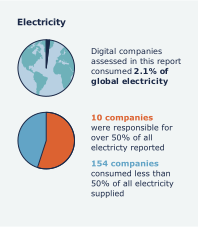
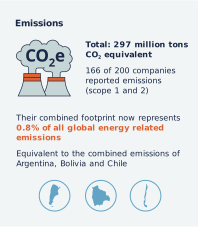
Figure 1: Consumption of digital companies evaluated.
Source: ITU and the WBA, Greening Digital Companies 2025
While 92 of the assessed digital companies have committed to achieving net-zero emissions—41 by 2050, 42 by 2040, and 9 by 2030—only a fraction have had their targets validated by the Science Based Targets initiative (SBTi). Even fewer include Scope 3 emissions in their disclosures. These indirect emissions, often from supplier networks, product usage, outsourced infrastructure and e-waste, are consistently the largest part of a company’s footprint, representing on average 84% of total emissions.
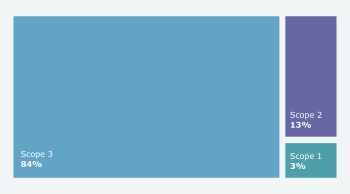
and indirect (Scope 3) emissions, 2023. Source: ITU and the WBA, Greening Digital
Companies 2025
Despite this, only around half of the companies assessed report complete Scope 3 inventories. This lack of transparency hampers the credibility of climate pledges, but also the ability to identify the most impactful decarbonization levers. Use-of-sold-products, purchased goods, and capital goods typically account for the majority of Scope 3 in digital companies, far outweighing office buildings or corporate travel.
Regional imbalances hinder global alignment
Companies based in Europe and North America tend to perform better on emissions disclosure and science-aligned target-setting. They also report significantly higher renewable electricity use: 67% in Europe and 70% in North America of electricity consumption comes from renewables. By contrast, firms operating in Asia-Pacific, Latin America and parts of Africa are large. East Asia and the Pacific alone account for 334 TWh of electricity usage, with only 12% covered by renewable energy. These regional disparities stem from a mix of factors: limited access to clean power, regulatory gaps, and lower investor scrutiny.
| Regions | Total energy consumption (TWh) | Total electricity consumption (TWh) | Renewable electricity used (TWh) | Renewable electricity share (%) |
| North America | 246 | 218 | 152 | 70 |
| Europe and Central Asia | 67 | 60 | 40 | 67 |
| East Asia and Pacific | 334 | 285 | 34 | 12 |
| South Asia | 11 | 3 | 1 | 32 |
| Latin America and Caribbean | 10 | 7 | 0 | 0 |
| Middle East and North Africa | 11 | 7 | 0 | 2 |
| Sub-Saharan Africa | 2 | 1 | 0 | 0 |
Table 1: Breakdown of total energy, electricity and renewable electricity consumption of the 200 companies by region; note that some companies report total electricity but not total energy, 2023.
Source: ITU and the WBA, Greening Digital Companies 2025
Yet these are precisely the regions where digital infrastructure is growing fastest. Without early alignment between infrastructure deployment and sustainability principles, the sector risks locking in high-emission pathways for decades. Addressing this mismatch is both a policy and investment imperative.
Governments and regulators will play a pivotal role in closing the climate accountability gap, especially in emerging markets. From mandatory reporting standards and tax incentives to public procurement guidelines and green bond frameworks, numerous tools are available to catalyse better climate performance across geographies.
Next-generation tech demands next-generation responsibility
Emerging technologies, including artificial intelligence, edge computing, and cloud-native applications, are intensifying the sector’s energy demands. Between 2017 and 2023, data centre electricity consumption grew four times faster than global demand. Training large language models (LLMs), running high-throughput inference, or deploying real-time services at scale requires enormous computational resources and sustained infrastructure availability. Unless these digital innovations are powered by clean energy and optimised for efficiency, they risk accelerating emissions instead of enabling their reduction.
At Axon, we have explored this trade-off extensively in our research. In “The Future of AI Depends on Data Centres, Are We Ready?”, we analyse how computational intensity is reshaping infrastructure needs, and propose concrete design interventions such as modular liquid cooling, low-carbon grid orchestration, and intelligent task allocation to reduce emissions by up to 40%. In a related white paper, “Balancing Growth and Green Goals in ICT”, we outline a sustainability roadmap that aligns AI and cloud scalability with carbon mitigation at both product and network levels.
These papers highlight a key shift: sustainability must no longer be treated as a post-deployment retrofit. It should be a founding principle of digital product architecture, from AI model design and data localisation strategies to procurement decisions and energy-aware code. These insights reinforce a broader imperative: digitalisation and decarbonisation must advance in lockstep. Achieving that requires not just incremental efficiency, but systemic redesign.
A chance to lead through accountability
The ITU-WBA report offers not just an assessment of the sector’s climate maturity, but also a roadmap for credible leadership. If the digital economy is to support rather than undermine global decarbonization efforts, companies must move from pledges to action, and from partial disclosures to full accountability.
That means:
- Publishing complete Scope 1, 2 and 3 inventories, with third-party assurance and standardised metrics.
- Setting science-aligned interim targets and embedding them into operational and investment planning.
- Prioritising energy performance in product and infrastructure design, including AI workloads and cloud architecture.
- Engaging regulators and policymakers, particularly in emerging markets, to advocate for reforms that enable clean power deployment and better reporting.
Authors

Víctor Martínez
Senior Manager

Pablo Cámara
Senior Associate
Disclaimer: The views expressed herein are based on best-available data and independent analysis of public sources, including the 2025 ITU-WBA “Greening Digital Companies” report. This article is intended to inform strategic dialogue and does not constitute legal, regulatory, or investment advice.