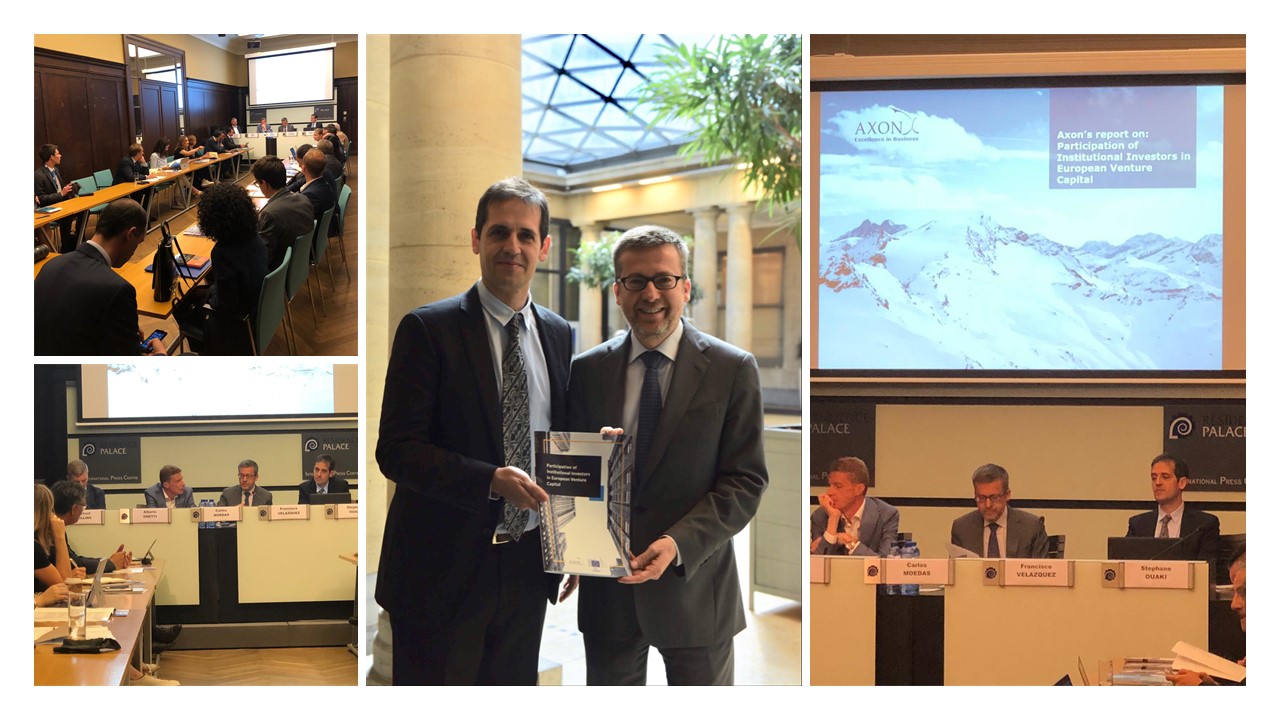
Axon Partners Group recently held a closed-door workshop with Commissioner Carlos Moedas, his team, and other distinguished guests to discuss key issues affecting European VC.
As part of the workshop, Axon’s president, Francisco Velázquez, presented the main findings and conclusions of our own publication, “Participation of European Institutional Investors in VC”. The research covered key reasons for the low participation of European Institutional Investors in VC by conducting a large-scale survey and interviews with Institutional Investors such as Pension Funds and Insurance Companies.
Axon has identified two primary constraints on investors’ ability to increase their allocation to VC. The most significant limitation observed was related to the perceived “Risk Return Profile” of VC. This limitation is based on three common beliefs: one, that buyout outperforms VC; two, that U.S. VC is still able to provide better returns; and three, that VC is too risky for institutional investors. As the report explains, the first two of the three reasons provided are not well supported by market data and represent an outdated perspective on the asset class. The third is indisputable, as VC shows the highest return dispersion among alternative strategies. However, as shown, VC also gains the largest benefit from diversification, which not only lowers the return dispersion but also shifts the median returns to the right.
The second group of constraints refers to the “Internal Limitations” faced by many institutional investors. These include minimum ticket/fund size problems and the lack of dedicated allocation to VC by European institutions. These limitations present a significant challenge in the context of European VC, as they set a minimum fund size of €300-500m in order to be investable. This size is highly uncommon in Europe due to the geographic focus of European funds, which makes them smaller. This is further compounded by the lack of internal expertise within these organisations, which means that most VC opportunities are simply disregarded before they can be analysed.
The European Commission and the participants have confirmed that programs such as VentureEU are on the right path to attract more private capital into European VC. Funds of Funds are a solution to many of the problems described above, as they provide a professional approach to the asset class needed to attract Institutional Investors. However, further actions are needed to promote the asset class and explain the current opportunity in Europe.